
Approx. 11 minutes read
Some links may earn Pete’s Aquatics a commission at no extra cost. Recommendations are based on fit, use case, and available product details. As an Amazon Associate I earn from qualifying purchases.
Why Are Your Shrimp Having Trouble Molting?
Table of Contents
- What is molting, and why are shrimp so picky about it?
- Why are your shrimp struggling to molt?
- Is the water just a little off?
- Is it the number, or the swing?
- Do Neocaridina and Caridina need the same minerals?
- Could their diet be causing molting problems?
- Could ammonia, nitrite, or nitrate be the real problem?
- Is stress a molting killer?
- Are chemicals sneaking into the tank?
- Could it be disease, parasites, or injury instead?
- Do they have enough places to hide?
- How can you help your shrimp molt smoothly?
- What are the signs your shrimp might be having molting issues?
- What do you do when a shrimp is stuck mid-molt?
- Common Questions
What is molting, and why are shrimp so picky about it?
Shrimp do not grow like we do. Instead of gradually getting bigger, they shed their hard exoskeleton in one big push. That process is called molting, and sometimes there can be “molting issues.” You can think of it like stepping out of an old, worn-out suit to grow into a new, bigger one. But here’s the kicker—it’s not exactly smooth sailing for them. After molting, shrimp are super vulnerable, and they need some TLC.
Young shrimp molt often because they are growing at breakneck speed. But as they age, that process slows down a little. To pull off a successful molt, they need just the right tank conditions. And if those conditions go sideways, molting can go from smooth to nightmare real fast.
Use this article as a care explainer. For quick species ranges, confirm your target values in the shrimp parameter cheat sheet, then compare the Neocaridina care guide or Caridina care guide for your shrimp type.
Free aquarium checklist
Get the Aquarium Cycling Cheat Sheet
Learn the ammonia, nitrite, and nitrate checkpoints that keep a new tank from turning into guesswork.
No spam. Unsubscribe anytime.
Why are your shrimp struggling to molt?
Most failed molts trace back to one of four things: an unstable water parameter (even within a normal range), a mineral mismatch between what Neocaridina and Caridina actually need, a diet too low in calcium, or built-up stress. Here’s how to check each one and fix it fast.
Is the water just a little off?
Shrimp can be picky, especially about water. Their small size means even tiny changes can mess them up. pH, temperature, and hardness—these are the things that matter most. When these swing too far out of balance, molting might take a hit.
Here’s what you need to watch:
- pH Levels: Aim for a pH between 6.5 and 7.5. If it strays too far from that, molting can get tricky. PH Test Kit
- Temperature: Keep it steady between 72°F and 78°F (about 22°C to 26°C). No big jumps!
- General Hardness (GH): Shrimp need calcium for their shells. A GH between 4-8 dGH will keep them on track. API GH/KH Test Kit
To stay on top of things, get yourself a decent test kit and check your water regularly. It’s the best way to make sure everything’s shrimp-friendly.
Is it the number, or the swing?
Here’s something that trips up a lot of keepers: a “good” GH or TDS reading is not the whole story. Shrimp do best when water changes are boring. A sudden swing in temperature, TDS, GH, KH, or pH can trigger stress and a failed molt, even if the final number lands inside the normal range.
Before you chase a fix, ask what actually changed in the last week:
- Did you do a larger-than-usual water change?
- Did you switch remineralizer or source water?
- Did you top off evaporation with mineralized water instead of plain water?
- Did TDS jump or drop sharply?
- Did temperature change quickly?
If the trouble started right after maintenance, compare the new water to the tank water. The closer those numbers are to each other, the safer the change usually is.
Do Neocaridina and Caridina need the same minerals?
No, and mixing up the two is a common reason people chase the wrong fix. Neocaridina are the more forgiving of the two and generally tolerate a wider mineral range. Caridina are often kept in softer, more acidic water with different remineralization needs entirely. If you keep both, do not assume one GH/KH target works for every tank.
Before adding minerals, know which shrimp you keep and test the tank first. Adding calcium blindly can create a new parameter swing or push TDS higher than it needs to be. If you are not sure where your tank should land, compare it against the Neocaridina care guide or Caridina care guide for your species.
Could their diet be causing molting problems?
Food plays a massive role in molting. If your shrimp are not getting the right nutrients, especially calcium, that fresh shell might not form properly after they molt. Kind of like how we need calcium for strong bones, shrimp need it to toughen up their new exoskeleton.
Here’s what they’ll love:
- Blanched veggies like spinach or kale. Yep, they munch on greens too.
- Calcium supplements (I like Liquid Calcium for Shrimp). This helps out if they’re struggling.
- Shrimp-specific foods like Bacter AE, which has all the good stuff they need.
One thing worth being honest about: nutrition problems are usually slower to show up than water-parameter problems. If a molt fails right after a water change, check the water first. If growth, breeding, or shell strength look weak over time, that is when diet deserves a closer look. And do not overdo the protein-heavy or powdered foods — leftover food fouls the water, which can hurt molting more than the food itself helps.
Could ammonia, nitrite, or nitrate be the real problem?
Molting problems are not always about minerals or calcium. Shrimp under nitrogen-cycle stress can fail molts because their whole system is under pressure, not just their shell.
Test ammonia and nitrite first — both should read zero in a stable shrimp tank, and nitrate should stay under 20 ppm. If ammonia or nitrite shows up at all, treat it as a tank-stability problem before you even think about supplements: cut back feeding, check the filter, remove any dead livestock, and get the cycle stable again.
Is stress a molting killer?
Picture a shrimp trying to shed its old shell while tankmates keep bothering it. That would be stressful, right? Well, shrimp go through the same thing. Stress is a molting nightmare. Overcrowded tanks, aggressive fish, or even too much fiddling around in the tank can throw shrimp off their game.
How to keep things calm:
- Avoid overcrowding. For Neocaridina shrimp, aim for about 20-30 shrimp in a 10-gallon tank.
- Go for peaceful tankmates like Otocinclus or small snails that will not give them trouble.
- Skip those big water changes. Small, weekly changes (10-15%) are better so you do not shock them.
Freshly imported or newly purchased shrimp are especially vulnerable here, since they may already be adjusting to very different water on top of the move itself. Drip acclimation helps, but the tank they land in still has to be stable. If shrimp are hiding constantly, darting around after maintenance, or have stopped grazing, treat that as a stress signal worth acting on.
Are chemicals sneaking into the tank?
Shrimp are delicate little creatures. Chemicals, especially copper, are a big no-go. Even a small amount can cause serious trouble. Medications, plant fertilizers—if you are adding anything to the tank, double-check that it is safe for shrimp.
To avoid any nasty surprises:
- Steer clear of products with copper. Seriously, shrimp do not mess with copper.
- If you need to treat the tank, go with shrimp-safe options like Seachem ParaGuard.
Could it be disease, parasites, or injury instead?
Sometimes a molt fails because the shrimp was already sick, injured, or weakened going in. Parasites, bacterial issues, physical damage, or shipping stress can all show up right around a molt, since molting is such a demanding process for them.
Watch for other symptoms alongside the failed molt:
- Fuzzy growths or unusual patches.
- Lethargy or loss of balance.
- Rust-colored marks or shell damage.
- A shrimp isolating itself from the group.
- Multiple deaths that do not line up with a water change.
Do not medicate blindly. Separate water-quality problems from disease signs first, and only choose a treatment path once the evidence actually points that way. As above, avoid anything with copper, and check the product label before using any medication.
Do they have enough places to hide?
When shrimp molt, they are soft and squishy until their new shell hardens. It is like wandering around without armor, so they need places to lay low. Without enough hiding spots, they might get stressed or even picked on by other fish.
Fix this by adding:
- Plants like Java Fern or Anubias to create natural hiding spots.
- Caves or driftwood for extra nooks and crannies. Shrimp love having cozy places to chill while they harden up.
How can you help your shrimp molt smoothly?
Want to keep your shrimp molting smoothly? Follow these steps and you will have happy, healthy shrimp in no time:
- Keep the water steady. Test pH, temperature, and GH on the regular. No sudden changes.
- Feed them a balanced diet. Give them calcium-rich foods, and consider a supplement if needed.
- Reduce stress. Make sure the tank has space and peaceful tankmates.
- Watch out for chemicals. Only add shrimp-safe products. No copper, ever.
- Give them hiding spots. Plants and caves work great, especially after they molt.
One more habit worth building in: match new water to tank water before it goes in. Match temperature, and get TDS and minerals as close as practical. Add new water slowly in sensitive tanks, and top off evaporation with plain source water rather than extra minerals. The goal is not to never change water — it is changing water without shocking the shrimp.
What are the signs your shrimp might be having molting issues?
Even if you do everything right, molting can still go wrong sometimes. Here are a few signs that your shrimp are struggling:
- They seem stuck in their old shell.
- They hide a lot more than usual.
- They are not eating, and they look weak.
- You notice them swimming weirdly or twitching around.
- You see a white ring around the body — a sign a molt may be about to fail, especially if minerals or water stability are off.
If you see any of these signs, check your water conditions first, and make sure their diet is up to snuff. Give them a little extra space to recover too.
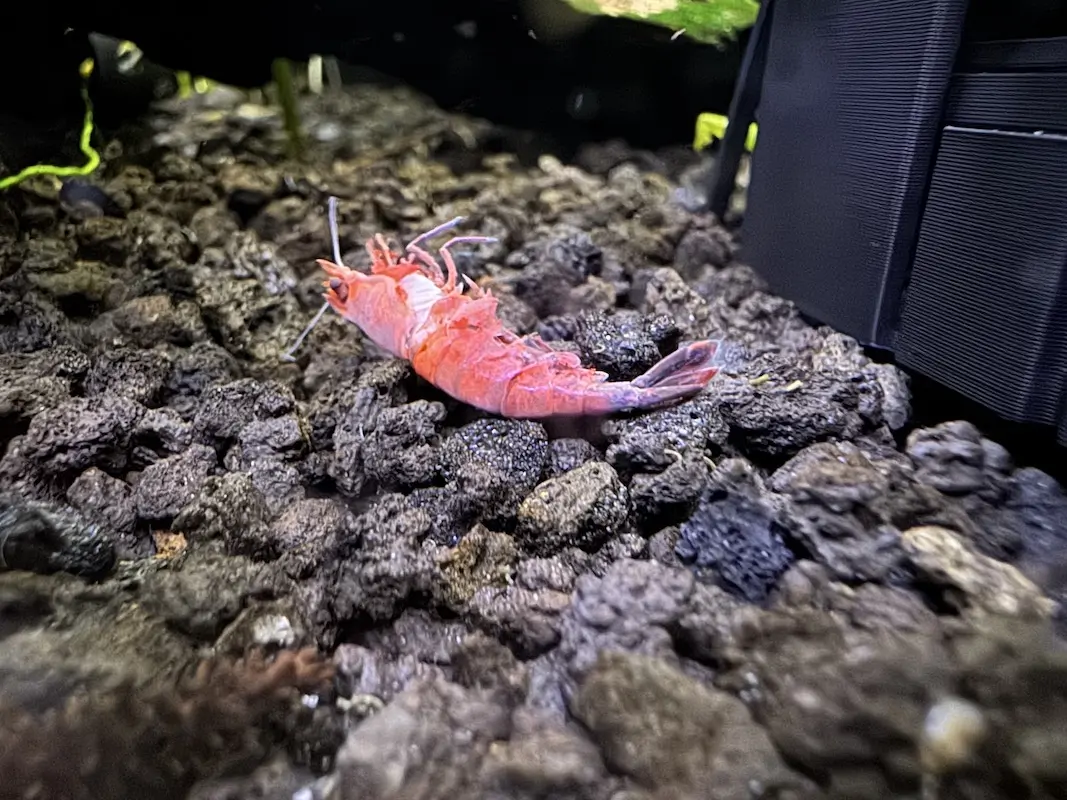
One more thing worth saying plainly: do not treat every molt as a problem. Healthy shrimp shed their exoskeleton as they grow, and a clear, empty shell in the tank is usually just a normal molt. The real warning sign is a shrimp that cannot finish the molt, dies during it, or shows repeated stress around molting.
What do you do when a shrimp is stuck mid-molt?
Honestly, there is usually not much you can do to save one shrimp once it is stuck in a failed molt. Pulling the shell off manually can injure or kill it. Your best move is protecting the rest of the colony instead:
- Test ammonia, nitrite, nitrate, GH, KH, and TDS.
- Compare those numbers to what your specific shrimp species needs.
- Check what changed in the tank over the last week.
- Remove any obvious stressors.
- Slow down future water changes.
- Watch whether the problem repeats.
If it is one isolated case in an otherwise stable colony, log it and keep watching. If it repeats across multiple shrimp, treat it as a tank-level problem and work back through the water-conditions, diet, and stress sections above.
Common Questions
Why did my shrimp die after molting?
A lot of things could cause this. Stress, bad water conditions, or lack of calcium can make molting dangerous. If you’re facing similar issues, read more on potential causes the shrimp parameter cheat sheet.
How often should shrimp molt?
Young shrimp molt about every week because they are growing quickly. Adults slow down, and they will usually molt every 3-4 weeks.
Can water changes mess with molting?
Yes, large changes in water parameters can stress your shrimp and mess with their molt. Stick to smaller, regular water changes to avoid shocking them. Molting soon after a water change is not automatically bad — it can be a normal growth trigger — but a large TDS or temperature swing raises the risk.
Is a white ring around a shrimp always fatal?
No, but treat it as a warning sign, not a diagnosis. A white ring can show up before a failed molt, especially when minerals or water stability are off. Test the tank and watch closely rather than guessing at a fix.
Should I add calcium if a molt fails?
Only add calcium or minerals when a test actually shows a reason to. Shrimp need minerals, but more is not automatically better. If GH is genuinely too low for your shrimp, remineralizing can help. If GH is already fine and TDS is high, adding more minerals can make the tank less stable. And if ammonia or nitrite is present, calcium will not fix that root problem at all. Test first, find the actual mismatch, adjust slowly, then watch how the tank responds.
Molting can be rough, but with the right care, your shrimp will breeze through it. Keep your water steady, feed them the good stuff, reduce stress, and watch out for chemicals. They will reward you with smooth molts and a long, healthy life. Have any questions or want to share your shrimp stories? Drop a comment below. Let’s keep learning and growing together!
Stay shrimp-tastic!