
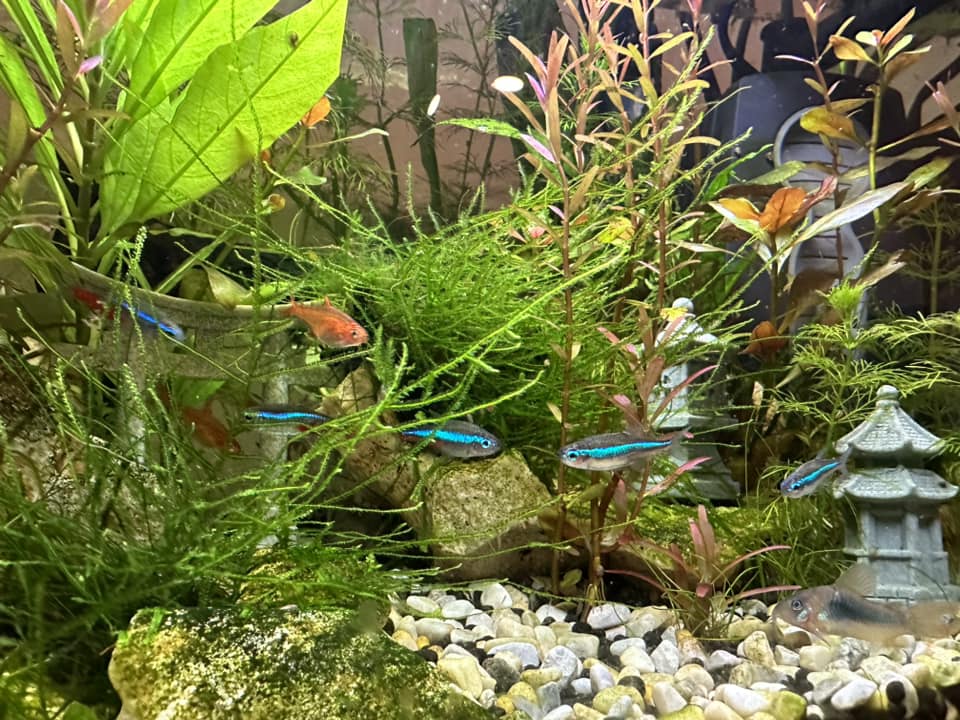
If you want a peaceful community tank, do not start with the prettiest fish on the store wall. Start with temperament, adult size, group size, water needs, and where each fish spends time in the aquarium.
Approx. 8 minutes read
A good community fish is not just “not aggressive.” It should be calm enough for shared space, small enough for the tank long term, comfortable in the same temperature and water range as its tank mates, and unlikely to bully slow fish, nip fins, or outcompete shy species at feeding time.
Quick Picks
| Goal | Best direction |
|---|---|
| Small schooling fish | Ember tetras, neon tetras, harlequin rasboras |
| Bottom activity | Corydoras, kuhli loaches, bristlenose pleco for larger tanks |
| Algae grazing | Otocinclus in mature planted tanks, bristlenose pleco in larger tanks |
| Beginner livebearers | Platies or guppies with a male/female plan |
| Calm centerpiece fish | Honey gourami, with tank mates chosen carefully |
| Cooler unheated setups | White Cloud Mountain minnows, if the room stays in their range |
For a first tank, also read the beginner aquarium setup guide and the beginner freshwater fish list. Peaceful fish still need a cycled filter, stable water, and enough room.
Free aquarium checklist
Get the Aquarium Cycling Cheat Sheet
Learn the ammonia, nitrite, and nitrate checkpoints that keep a new tank from turning into guesswork.
No spam. Unsubscribe anytime.
What Makes A Fish Peaceful?
A peaceful community fish usually has these traits:
- It does not defend a large territory.
- It is not a regular fin nipper.
- It is not large enough to swallow smaller tank mates.
- It eats without bullying slower fish.
- It can live in a group without constant chasing.
- Its temperature, hardness, and pH needs overlap with the rest of the tank.
This is why a fish can be peaceful in one setup and stressful in another. A calm honey gourami in a planted 20-gallon tank may not act the same in a cramped tank with fast livebearers. A small tetra can be peaceful in a school but nervous and nippy when kept alone.
15 Peaceful Community Fish To Consider
1. Neon Tetras
Neon tetras are small, colorful schooling fish that work best in mature, stable aquariums. Keep them in a group of at least six, with more being better when the tank has enough room.
Best fit: planted community tanks with calm tank mates.
Watch for: unstable new tanks, large fish that may see them as food, and very boisterous tank mates.
2. Ember Tetras
Ember tetras are tiny orange schooling fish that are usually calmer than many larger community fish. They look best in planted tanks and should be kept in a group.
Best fit: smaller peaceful aquariums where tank mates are not big enough to eat them.
Watch for: strong flow, large fish, and underfeeding if faster fish dominate the surface.
3. Harlequin Rasboras
Harlequin rasboras are one of the better beginner-friendly schooling fish for peaceful tanks. They are active without usually being rough, and their copper color stands out well against plants.
Best fit: peaceful planted tanks, especially 20 gallons and up.
Watch for: keeping too few. A proper group makes them less nervous.
4. Rummy Nose Tetras
Rummy nose tetras are excellent schooling fish, but they are best for keepers who can keep water quality stable. Their tight schooling behavior makes them a strong choice for larger peaceful aquariums.
Best fit: stable, mature tanks with open swimming space.
Watch for: poor acclimation, sudden water changes, and brand-new tanks.
5. Cherry Barbs
Cherry barbs are much calmer than tiger barbs and are one of the safer barb choices for a community aquarium. They do best in groups with plant cover.
Best fit: planted community tanks with other peaceful fish.
Watch for: confusing cherry barbs with more aggressive barb species. Not every barb is a peaceful community fish.
6. White Cloud Mountain Minnows
White Cloud Mountain minnows are hardy, active schooling fish that prefer cooler water than many tropical fish. They can be a good fit for unheated or cooler-room setups.
Best fit: cooler community tanks with similar temperature needs.
Watch for: mixing them into warmer tropical setups just because they are hardy.
7. Guppies And Endlers
Guppies and Endlers are colorful, active livebearers that can work well in peaceful tanks. They are especially good for beginners who understand that they breed quickly.
Best fit: active beginner community tanks with similar-sized fish.
Watch for: overbreeding, male harassment, and long fins around fin nippers. Consider all-male, all-female, or planned breeding groups.
8. Platies
Platies are sturdy livebearers with a calm enough temperament for many community tanks. They are more substantial than tiny tetras and often do well in beginner aquariums.
Best fit: beginner community tanks with room for active swimmers.
Watch for: breeding, crowding, and mixing with fish that need much softer water.
9. Corydoras Catfish
Corydoras are peaceful bottom-dwellers that should be kept in groups. They are social fish, not cleanup tools, and they still need proper food that reaches the bottom.
Best fit: community tanks with soft sand or smooth substrate.
Watch for: sharp substrate, underfeeding, and keeping one or two alone.
10. Kuhli Loaches
Kuhli loaches are peaceful bottom fish that like hiding places, soft substrate, and groups. They are more visible when they feel secure.
Best fit: peaceful planted or shaded tanks with caves, leaf litter, or other cover.
Watch for: rough substrate, aggressive bottom fish, and filter gaps where they can squeeze in.
11. Otocinclus Catfish
Otocinclus are gentle algae grazers for mature tanks with steady biofilm and algae growth. They are not a good fix for a brand-new tank with no grazing surface.
Best fit: mature planted community aquariums.
Watch for: adding them too early, starving them, or assuming they replace regular maintenance.
12. Bristlenose Plecos
Bristlenose plecos are peaceful algae-grazing catfish for larger community tanks. They stay much smaller than common plecos, but they still need space, wood, hiding areas, and dedicated food.
Best fit: larger community tanks where a bottom grazer has room.
Watch for: small tanks, multiple territorial plecos, and assuming algae alone is enough food.
13. Honey Gouramis
Honey gouramis are one of the better calm centerpiece fish for peaceful aquariums. They are usually a safer community choice than dwarf gouramis, though individual behavior still matters.
Best fit: planted tanks with gentle tank mates and calm surface movement.
Watch for: aggressive males, fin nippers, and stressful fast-moving tank mates.
14. Zebra Danios
Zebra danios are hardy and peaceful in the sense that they are not usually aggressive, but they are fast and active. They work best with fish that can handle their energy.
Best fit: active community tanks with open swimming room.
Watch for: pairing them with slow, shy, or long-finned fish that may be stressed by constant movement.
15. Dwarf Gouramis, Mollies, And Swordtails With Caution
These fish can work in community tanks, but they are not automatic peaceful picks. Male dwarf gouramis can be territorial. Mollies and swordtails are active livebearers that may need more room and can chase tank mates.
Best fit: planned tanks where adult size, sex ratio, water hardness, and temperament are considered.
Watch for: adding them to small peaceful tanks just because they are common in stores.
Compatibility Checklist
Before combining community fish, check:
- Adult size: avoid fish that can eat smaller tank mates.
- Group size: schooling fish need groups, not singles.
- Temperature: do not mix cool-water and warm-water fish casually.
- Water hardness: livebearers often prefer harder water than many soft-water schooling fish.
- Swimming zone: mix top, middle, and bottom fish so one area is not crowded.
- Feeding speed: make sure bottom fish and shy fish actually get food.
- Flow tolerance: danios may enjoy more movement than gouramis or long-finned fish.
Use the water testing guide before adding fish, especially if the tank is new or you are changing stocking.
Sample Peaceful Community Plans
Smaller Calm Community
For a modest peaceful setup, pick one small schooling fish, one bottom group if the tank footprint allows it, and avoid a centerpiece fish until the tank is stable.
Example direction: ember tetras or neon tetras with corydoras, if the tank is large enough for both groups.
Planted 20-Gallon Community
A 20-gallon planted tank gives you more room to balance swimming zones. A common direction is one schooling fish, one bottom group, and one calm centerpiece fish.
Example direction: harlequin rasboras, corydoras, and a honey gourami.
Active Beginner Livebearer Tank
If you like movement and color, platies or guppies can be a strong beginner direction. Plan for breeding before you buy males and females together.
Example direction: platies with corydoras in a properly sized tank, or an all-male guppy group with peaceful tank mates.
Fish I Would Not Treat As Automatic Peaceful Picks
Be careful with:
- Tiger barbs and other regular fin nippers.
- Large cichlids that can eat or bully smaller fish.
- Bettas, because personality varies and long fins can be a problem with active tank mates.
- Common plecos, because they outgrow most home aquariums.
- Goldfish in tropical community tanks, because temperature, waste, and diet needs do not match most tropical community fish.
If you are unsure whether a fish is sick, stressed, or being bullied, start with the Fish Health hub before adding more livestock.
Gear And Setup Notes
Peaceful fish are easier to keep peaceful when the aquarium is stable:
- Use a filter sized for the tank and stocking level.
- Add plant cover, driftwood, or hardscape breaks so fish can leave each other’s line of sight.
- Cycle the aquarium before adding a full community.
- Add fish in stages instead of stocking everything at once.
- Keep a regular testing and water-change routine.
For gear planning, use the Aquarium Equipment Finder. For filter comparison, start with the 10-gallon HOB filter comparison or the Filtration hub.
Bottom Line
The most peaceful community fish are the ones that fit your actual tank, not just a generic top-15 list. Start with calm schooling fish, compatible water needs, proper group sizes, and enough room for each fish to behave naturally.
If this is your first aquarium, build the tank around stability first. Peaceful stocking works best after the filter is cycled, the water parameters are predictable, and each fish has the space and group structure it needs.