
Approx. 20 minutes read
Some links may earn Pete’s Aquatics a commission at no extra cost. Recommendations are based on fit, use case, and available product details. As an Amazon Associate I earn from qualifying purchases.
#pa-api-prime-article { max-width: 900px; margin: 0 auto; color: #1f2a2e; font-size: 18px; line-height: 1.72; } #pa-api-prime-article .pa-ap-hero { padding: 0 0 18px; } #pa-api-prime-article h1 { font-size: clamp(2rem, 4vw, 3.15rem); line-height: 1.08; margin: 0 0 18px; letter-spacing: 0; } #pa-api-prime-article h2 { margin: 42px 0 14px; font-size: 1.75rem; line-height: 1.2; letter-spacing: 0; } #pa-api-prime-article h3 { margin: 28px 0 10px; font-size: 1.22rem; line-height: 1.3; letter-spacing: 0; } #pa-api-prime-article p { margin: 0 0 18px; } #pa-api-prime-article a { color: #0b6f7d; text-decoration-thickness: .08em; text-underline-offset: .18em; } #pa-api-prime-article .pa-ap-section:nth-of-type(2n) { padding: 18px 20px; background: #f7fafc; } #pa-api-prime-article .pa-ap-section:nth-of-type(2n+1) { padding: 4px 0; } #pa-api-prime-article #pa-ap-toc { margin: 24px 0 34px; padding: 18px 20px; background: #f7fafc; border-left: 4px solid #607d8b; } #pa-api-prime-article #pa-ap-toc-heading { margin: 0 0 12px; font-size: 1.3rem; } #pa-api-prime-article #pa-ap-toc-list { margin: 0; padding-left: 1.2em; } #pa-api-prime-article #pa-ap-toc li { margin: 0 0 8px; } #pa-api-prime-article .pa-ap-list { margin: 0 0 22px 1.2em; padding: 0; } #pa-api-prime-article li { margin: 0 0 8px; } #pa-api-prime-article .pa-ap-table-wrap { overflow-x: auto; margin: 22px 0 28px; } #pa-api-prime-article table { width: 100%; border-collapse: collapse; min-width: 680px; font-size: .96rem; } #pa-api-prime-article th { text-align: left; background: #e8f2f1; padding: 12px; border-bottom: 2px solid #b7d5d1; } #pa-api-prime-article td { vertical-align: top; padding: 12px; border-bottom: 1px solid #d9e6e4; } #pa-api-prime-article .pa-ap-section:nth-of-type(5), #pa-api-prime-article .pa-ap-section:nth-of-type(9), #pa-api-prime-article .pa-ap-section:nth-of-type(14) { padding: 18px 20px; background: #fff8ed; } @media (max-width: 680px) { #pa-api-prime-article { font-size: 16px; line-height: 1.66; } #pa-api-prime-article h1 { font-size: 2rem; } #pa-api-prime-article h2 { font-size: 1.45rem; } #pa-api-prime-article h3 { font-size: 1.12rem; } #pa-api-prime-article .pa-ap-section:nth-of-type(2n), #pa-api-prime-article .pa-ap-section:nth-of-type(5), #pa-api-prime-article .pa-ap-section:nth-of-type(9), #pa-api-prime-article .pa-ap-section:nth-of-type(14) { padding: 14px 16px; } }API Aqua Essential vs Seachem Prime: Which One Should You Use?
API Aqua Essential vs Seachem Prime sounds like a boring product comparison until you stand near a tank with tap water in a bucket, fish waiting, and an ammonia test that makes your stomach tighten.
Water conditioner does not get aquarium keepers fired up. Nobody posts glamour shots of a dechlorinator bottle next to moss and driftwood. At least I hope not. Still, if we keep fish or shrimp, this boring little bottle earns shelf space.
I have learned to respect boring aquarium routines. The tanks that give me fewer headaches usually follow the same rhythm every time: test, condition the water, match temperature, change water, avoid overfeeding, and leave the filter bacteria alone. Not flashy. Very effective.
So when someone asks me about API Aqua Essential vs Seachem Prime, I do not start with brand loyalty. I start with the person holding the bottle. Are you measuring carefully? Are you treating tap water before it hits livestock? Are you testing during ammonia or nitrite trouble? Are you trying to use conditioner as a shortcut for a tank that has not cycled yet?
That is where the real answer lives.
Short version: API Aqua Essential fits beginners who want simple directions and a clear routine. Seachem Prime fits keepers who want a concentrated conditioner, better long-term value, and enough discipline to measure small doses correctly. Both can help. Neither replaces water testing, water changes, oxygen, or a healthy biological filter.
A conditioner can make a bad day less bad. It cannot turn poor tank care into good tank care.
Free aquarium checklist
Get the Aquarium Cycling Cheat Sheet
Learn the ammonia, nitrite, and nitrate checkpoints that keep a new tank from turning into guesswork.
No spam. Unsubscribe anytime.
Quick Verdict
| Situation | Better fit | Why |
|---|---|---|
| Beginner weekly water changes | API Aqua Essential | Simple directions, easy routine use, clear tap-water role |
| Large tanks or many tanks | Seachem Prime | Very concentrated, treats a lot of water per bottle |
| Tiny nano tanks | API Aqua Essential or carefully measured Prime | Prime works, but tiny doses need a syringe or pipette |
| Ammonia or nitrite emergency | Test first, water change first, then label-based support | Neither bottle should become the whole plan |
| Shrimp tanks | Either, with careful dosing and stable parameters | Stable water matters more than brand arguments |
| Long-term budget | Seachem Prime | Concentration usually stretches farther |
The big split is not “good product versus bad product.” Both products have a place. The better question is how you use conditioner and what kind of mistake you are most likely to make.
If your likely mistake is under-dosing tap water during routine water changes, pick the bottle with directions you will follow every time. If your likely mistake is wasting money across several tanks, Prime starts looking better. If your likely mistake is panic-dosing during ammonia trouble, neither product solves the real issue until you test, change water, add oxygen, and protect the biofilter.
Buy for your habits, not for the loudest argument online.
What Do API Aqua Essential And Seachem Prime Actually Do?
Both products are aquarium water conditioners. Their first job is to make tap water safer for fish, shrimp, snails, plants, and the bacteria that keep our tanks alive.
Municipal tap water exists for people, not aquariums. Chlorine and chloramine help keep drinking water safer, but fish and shrimp need treated water before it enters the tank.
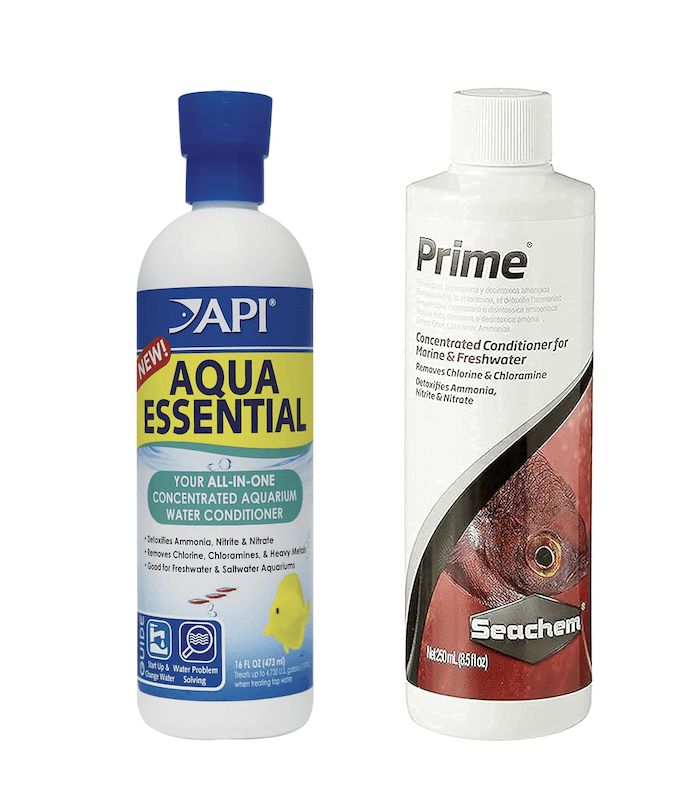
The official API Aqua Essential page says Aqua Essential removes chlorine and chloramines, neutralizes heavy metals, and has separate dosing guidance for normal tap-water treatment versus ammonia, nitrite, and nitrate response.
The official Seachem Prime page says Prime removes chlorine and chloramine, detoxifies ammonia, nitrite, and nitrate, and uses a concentrated dose where 5 ml treats 50 gallons for standard use.
Those claims sound similar. That is why this comparison trips people up. The real difference sits in concentration, dosing style, label clarity, and how each bottle fits your routine.
Chlorine Versus Chloramine
Chlorine is more straightforward for many conditioners to handle. Chloramine is chlorine bonded with ammonia, and many water suppliers use it since it lasts longer in the water system.
That matters for fishkeepers. Once chloramine enters the conversation, ammonia can enter the conversation too. This is one reason a good conditioner label talks about more than chlorine alone.
If you have never checked your local water report, give it a look at some point. You do not need to turn into a municipal-water detective. Still, knowing whether your tap uses chlorine or chloramine helps you understand why conditioner is not optional.
Heavy Metals
Both products discuss heavy metals in their official product copy. Heavy metals can come from source water or plumbing, and sensitive livestock may react poorly.
That does not mean a conditioner gives us permission to ignore suspicious source water, copper exposure, or old pipes. If shrimp or sensitive fish act odd after every water change, test source water and review the whole routine.
Detoxify Does Not Mean Your Tank Is Fixed
This is where aquarium advice gets messy.
When a conditioner says it detoxifies ammonia, nitrite, or nitrate, do not read that as “my tank problem is gone forever.” It means the product may temporarily make certain waste compounds less harmful when you use it according to the label. The waste still needs a path out of the system.
Your tank still needs:
- A working nitrogen cycle
- Enough biological filtration
- Correct stocking
- Sensible feeding
- Regular water changes
- Stable oxygen
- Regular water testing
If you dose conditioner every day and ammonia keeps coming back, the bottle is not the problem. The tank is telling on itself.
Maybe the tank has not cycled. Maybe the filter media got rinsed too aggressively. Maybe a dead snail is hiding under wood. Maybe food is rotting in the substrate. Maybe the tank has more fish than the filter can handle.
If ammonia sits at the center of the mess, Pete’s guide on what causes ammonia in a fish tank should sit next to this article.
A conditioner is support, not a magic eraser.
Dosing: API Aqua Essential vs Seachem Prime
Dosing is where these two products start to feel different.
API Aqua Essential’s official directions list 5 ml per 50 gallons for tap-water treatment. API lists a higher dose, 5 ml per 10 gallons, for ammonia, nitrite, and nitrate response.
Seachem Prime’s standard dose is 5 ml per 50 gallons. Seachem notes that each cap thread equals roughly 1 ml. Seachem’s directions include higher emergency dosing guidance for nitrite situations.
Here is the practical version:
- Both can treat tap water at 5 ml per 50 gallons.
- API gives a clearly separated higher dose for ammonia, nitrite, and nitrate response.
- Prime is highly concentrated and stretches far.
- Tiny tanks need careful measuring with either product.
- Concentrated products punish sloppy measuring faster.
Easy Dose Examples
For standard tap-water treatment, both official labels point to 5 ml per 50 gallons.
| Water volume | Standard dose at 5 ml per 50 gallons |
|---|---|
| 5 gallons | 0.5 ml |
| 10 gallons | 1 ml |
| 20 gallons | 2 ml |
| 30 gallons | 3 ml |
| 50 gallons | 5 ml |
For API Aqua Essential’s higher ammonia, nitrite, and nitrate response dose, the official API page lists 5 ml per 10 gallons.
| Water volume | API higher response dose at 5 ml per 10 gallons |
|---|---|
| 5 gallons | 2.5 ml |
| 10 gallons | 5 ml |
| 20 gallons | 10 ml |
| 30 gallons | 15 ml |
| 50 gallons | 25 ml |
Always follow the current label on your bottle. Labels can change, and your actual water volume may sit lower than the tank size after substrate, wood, rocks, plants, and equipment.
Actual Water Volume Matters
A “20-gallon tank” rarely holds 20 gallons of water once hardscape and substrate enter the picture. During routine water changes, dose for the amount of new water you treat unless the label tells you something different for the situation.
If you change 5 gallons from a 20-gallon tank, you usually treat the 5 gallons of new tap water. You do not always dose for the whole aquarium during a normal water change.
Emergency use can work differently. Read the bottle and think through the problem instead of guessing.
If you keep a 5-gallon shrimp tank, do not splash Prime into the bucket and call it good. Use a syringe, pipette, or measuring cap. The smaller the tank, the less room you have for sloppy dosing.
I like writing the dose for each tank on a piece of tape near the conditioner bottle or bucket. Not fancy. Works great.
Which One Is Better For Weekly Water Changes?
For normal weekly water changes, both products can work well.
API Aqua Essential earns points for clear directions. Add the correct amount to new tap water, mix, match temperature, and change the water. For a beginner already learning cycling, stocking, food, filters, heaters, algae, and that one fish that acts like it has never eaten in its entire life, simple directions matter.
That is why I do not mock beginner-friendly products. Clear instructions are not a weakness. Clear instructions act like a safety rail.
Seachem Prime earns points for concentration and long-term value. A small bottle treats a lot of water. Once you keep more than one tank, your relationship with conditioner changes. A bottle that seemed like it would last forever suddenly shrinks after a few big water-change days.
In a fish room or shrimp rack, I want repeatable systems. Same bucket. Same measuring tool. Same dose math. Same routine every time. If a product is concentrated, I respect it. Concentrated does not mean scary. It means measure it like you mean it.
My routine preference: Prime for larger tanks, multi-tank setups, and careful keepers. API Aqua Essential for readers who want a very clear beginner-friendly bottle and do not mind buying more product over time.
Bucket Method
The bucket method is simple:
- Fill the bucket with tap water.
- Add the correct conditioner dose.
- Mix the water.
- Match temperature as closely as practical.
- Add the water slowly to the aquarium.
This method fits small tanks, shrimp tanks, quarantine tanks, and fry tanks. It gives you control before new water touches livestock.
Direct-To-Tank Method
Some keepers dose the aquarium and refill straight from the tap or a Python-style water changer. This can work in larger aquariums when done carefully, but beginners should understand the risk: untreated tap water can contact fish, shrimp, plants, and filter bacteria before conditioner mixes through the system.
If you use this method, dose accurately, add water at a safe temperature, refill gently, and keep strong circulation. For sensitive livestock, I still prefer pre-treating new water when practical.
Which One Is Better During Ammonia Or Nitrite Trouble?
If your test kit shows ammonia or nitrite, pause before grabbing any bottle.
First, ask:
- What is the ammonia reading?
- What is the nitrite reading?
- Is this tank new?
- Did you clean or replace filter media?
- Did you overfeed?
- Did a fish, shrimp, snail, or plant mass die?
- Is the filter running normally?
- Are fish gasping or acting stressed?
When a test turns a bad color, people want to do something right away. I get that. I have felt that little jolt too. The trick is doing the useful thing first, not the dramatic thing first.
Useful usually means water change, oxygen, less food, finding the source, and protecting the biofilter. Dramatic means dumping in extra products, mixing bottles, and hoping the tank forgives us. Tanks do not always forgive us.
What I Would Do With A Bad Reading
- Confirm the test with a second reading if the color looks odd.
- Check tap water so you know whether the source water contributes to the result.
- Change water if livestock are at risk.
- Add an air stone or increase surface movement.
- Feed lightly or pause briefly, depending on livestock.
- Look for hidden dead livestock or rotting food.
- Check whether the filter is clogged, unplugged, or recently over-cleaned.
- Dose conditioner according to the label when it fits the situation.
That sequence sounds boring. It saves fish.
Both API Aqua Essential and Seachem Prime include label guidance related to ammonia and nitrite. That can help during a bad moment. It should not become your maintenance plan.
Nitrite is especially rough on fish. If you are still sorting out nitrite versus nitrate, read Pete’s guide on nitrate vs nitrite before guessing from a color chart.
Fish-In Cycle Note
During a fish-in cycle, a conditioner can reduce risk while the biological filter matures, but the tank still needs daily testing and careful water changes. Do not treat fish-in cycling like a mature aquarium. The bacteria are not fully established yet, so the tank can swing fast.
If you are cycling with fish already in the tank, use a test kit, conditioner, light feeding, and patience. The goal is to get through the cycle without letting ammonia or nitrite hurt the fish.
What About Test Kit Readings After Dosing Conditioner?
This part confuses a lot of people.
You dose conditioner. You test again. The ammonia still shows on the kit. So did the product fail?
Maybe not.
Some conditioners can bind or detoxify ammonia while certain test kits still detect total ammonia. In plain English, the kit may show ammonia-related compounds still present even if some of that ammonia sits in a less harmful form for a short period.
Do not use that as permission to ignore ammonia. Use it as a reason to track the full situation:
- Test source tap water.
- Test the tank before dosing.
- Dose according to the label.
- Watch fish behavior.
- Retest on a sensible schedule.
- Confirm the tank is cycling properly.
Total Ammonia Versus Free Ammonia
Many hobby tests report total ammonia, which can include ammonia and ammonium. Free ammonia is the more dangerous form, and its risk changes with pH and temperature. Higher pH and warmer water can make ammonia more dangerous.
This is why one aquarium can look less risky at a low total ammonia reading while another tank at higher pH may face more risk. A single test result without pH, temperature, and fish behavior can mislead a beginner.
Read The Tank, Not Just The Tube
Test kits matter. Fish behavior matters too.
Watch for:
- Gasping
- Clamped fins
- Hanging near the surface
- Hiding suddenly
- Red or irritated gills
- Loss of appetite
- Flashing
If fish act stressed and the test looks questionable, treat the situation as real until you prove otherwise.
If your readings confuse you, step back and build a full picture. Pete’s water parameter testing guide walks through the core numbers without turning the hobby into a chemistry lecture.
Is Either Product Better For Shrimp Tanks?
Shrimp keepers worry about every bottle that goes near the tank. I get it. Shrimp can be hardy once settled, but they do not love sudden change.
API lists Aqua Essential for freshwater, saltwater, shrimp, and other aquatic animals on its official product page. Many aquarists use Prime in freshwater systems too. With shrimp, the bigger issue is usually stability and correct dosing.
Shrimp are tiny little drama detectors. They may look peaceful while grazing on biofilm, but rough changes get noticed fast. I care much more about stable water than brand arguments in shrimp tanks.
For shrimp tanks:
- Pre-treat new water.
- Match temperature.
- Keep GH and KH stable.
- Avoid large sudden TDS swings.
- Add water slowly.
- Measure conditioner with a syringe.
- Keep copper-containing products away unless you know exactly what you are doing.
If shrimp are breeding, grazing, molting cleanly, and acting normal, do not go looking for reasons to change the routine. That is how people turn a stable tank into a science fair project nobody asked for.
Shrimp like boring water. I will happily be boring if it keeps them grazing, molting, and breeding.
Product Links And Buyer Notes
| Product | Best for | Verified link |
|---|---|---|
| API Aqua Essential | Simple routine water changes, beginner-friendly dosing, readers who want clear label separation for tap water and waste response | Check Amazon Price |
| Seachem Prime | Concentrated value, larger tanks, fish rooms, emergency backup when measured carefully | Check Amazon Price |
My rule for affiliate links is simple: the link should help you solve the problem in the article. If the link does not help, it does not belong there. You do not need five conditioners, three emergency bottles, and a cabinet full of “just in case” liquids to keep a healthy tank.
One conditioner you understand beats a pile of bottles you use when nervous.
What To Buy With Conditioner
A conditioner is only one part of a water-quality kit. The more useful starter bundle is:
- A reliable freshwater test kit
- One conditioner you understand
- A dedicated bucket
- A gravel vacuum or siphon
- A thermometer
- A measuring syringe
If money is tight, buy the test kit and one conditioner before extra additives. You can solve a lot of problems with testing, water changes, and restraint.
Beginner Tips
If you are new to aquariums, make your water-change routine repeatable.
Keep these together:
- Water conditioner
- Test kit
- Dedicated bucket
- Thermometer
- Measuring syringe or cap
- Towel
- Siphon
Write down your dose. If your tank needs 1 ml, write 1 ml. If your bucket needs 2 ml, write 2 ml. Future-you will appreciate not doing math while holding a wet hose.
Treat new tap water before it enters the tank when practical. Match temperature. Pour slowly. Avoid blasting shrimp, fry, or stressed fish with a sudden current.
If you are doing a fish-in cycle, use extra caution. Conditioner may help keep livestock safer during a rough patch, but your real goal is a mature biological filter. Pete’s cycling guide is the one to read before test colors start making you second-guess everything.
Advanced Notes For Experienced Keepers
If you keep multiple tanks, dosing math starts to matter more.
Prime is attractive in a fish room since it is concentrated. A small bottle can handle a lot of water changes. That said, concentration can become a liability if you dose casually in tiny tanks, fry tubs, shrimp tanks, or quarantine containers.
API Aqua Essential may feel less efficient in a larger setup, but the separated dosing language can help when you teach someone else to maintain a tank. Clear instructions reduce mistakes.
A few practical habits help with either product:
- Use a syringe for small water volumes.
- Dose for the actual water volume changed, not always the full tank.
- Keep product caps clean.
- Do not mix conditioners together unless you have a real reason.
- Test source water when municipal treatment changes.
- Keep an emergency bottle on hand before you need it.
If you run a rack or breeder setup, one bottle living near the water station beats five half-empty bottles scattered across shelves. Pick your system and make it repeatable.
Mistakes To Avoid
The first mistake is thinking conditioner fixes every water problem.
It does not.
The second mistake is chasing ammonia readings with repeated doses while ignoring the source. If ammonia keeps coming back, something is producing it or the biofilter is not processing it.
The third mistake is overdosing tiny tanks since the product seems harmless. Measure it.
The fourth mistake is skipping water changes during a spike since a conditioner says it detoxifies ammonia or nitrite. If waste is building up, remove some waste water and replace it with safe water.
The fifth mistake is forgetting oxygen. Fish struggling through ammonia, nitrite, stress, or medication often need more aeration. Surface movement costs little and helps a lot.
FAQ
1. Is API Aqua Essential Better Than Seachem Prime?
API Aqua Essential is better for some beginners since the directions are easy to understand and the product feels straightforward for routine water changes. Seachem Prime is better for many larger tanks, fish rooms, and long-term value since it is concentrated and treats a lot of water per bottle.
Neither product wins every tank. The right pick depends on tank size, dosing habits, budget, and comfort with measuring small liquid doses.
2. Can I Use Seachem Prime Every Water Change?
Yes, Seachem Prime is designed for routine water conditioning when used according to the label. Dose accurately, treat the correct water volume, and avoid casual overdosing in small tanks.
For tiny tanks, use a syringe or pipette. Guessing a few drops may seem harmless, but small tanks give you less room for sloppy habits.
3. Can API Aqua Essential Or Prime Fix An Ammonia Spike?
They can help support the tank during ammonia trouble when used according to the label, but they do not fix the root cause. You still need to test water, change water when needed, add aeration, reduce waste, and figure out why ammonia appeared.
If ammonia keeps coming back, look at cycling, filter health, stocking, feeding, and hidden decaying material.
4. Why Does My Ammonia Test Still Show Ammonia After Conditioner?
Some tests can still read total ammonia after a conditioner binds or detoxifies ammonia. That does not always mean the conditioner failed, but it does not mean you should ignore the result.
Track the full picture: test source water, test the tank, check pH and temperature, watch fish behavior, and keep water changes ready if livestock look stressed.
5. Are These Conditioners Safe For Shrimp?
API lists Aqua Essential for freshwater, saltwater, shrimp, and other aquatic animals on its official product page. Many aquarists use Prime in freshwater systems as well. With shrimp, the bigger issue is stability and correct dosing.
Pre-treat water, measure carefully, avoid sudden parameter swings, and keep copper or unsafe medications away from shrimp tanks.
6. Can I Use Too Much Water Conditioner?
Yes, you can use too much of almost anything in an aquarium. Many conditioners have some margin for label-directed emergency use, but that does not make random overdosing smart.
Dose for the correct water volume. Add aeration during emergency use. Read the current bottle label before increasing any dose.
7. Should I Keep Both API Aqua Essential And Seachem Prime?
Most keepers only need one conditioner they understand well. Keeping both can make sense if you are comparing products, managing several tanks, or want a backup bottle, but it is not required.
If you keep both, label them clearly and do not dose both at the same time unless you have a specific reason and know what each product does.
So, Which Bottle Would I Pick?
For a first aquarium, I like API Aqua Essential as a simple, beginner-friendly water conditioner. It is easy to explain, easy to build into a routine, and useful for a reader who wants fewer aquarium decisions, not more.
For long-term fishkeeping, especially with bigger tanks or several aquariums, I lean toward Seachem Prime. It is concentrated, common in the hobby, and efficient when measured correctly.
That said, the best product is the one you dose correctly and pair with good aquarium habits. A careful beginner with API Aqua Essential beats a careless keeper with Prime every day of the week.
Final Takeaway
If you came here hoping for a dramatic winner, sorry. This is aquarium keeping, not a boxing match. API Aqua Essential and Seachem Prime can both do the job when used correctly.
API Aqua Essential is the simple beginner-friendly pick. Seachem Prime is the concentrated value pick. Both require correct dosing, testing, water changes, oxygen, and common sense.
The bigger win is building a water-change routine you can repeat without thinking too hard. Your fish and shrimp do not care which label looks cooler. They care about clean, conditioned, stable water.
That is the unglamorous truth. The unglamorous truth saves livestock.
If you are deciding between these two for a specific tank, drop your tank size, livestock, and water-change routine in the comments. I would rather help you build a sane routine than watch you buy three bottles you do not need.